CORVEL (CRVL)·Q3 2026 Earnings Summary
CorVel Stock Drops 17% Despite Modest Earnings Beat as Growth Decelerates
February 03, 2026 · by Fintool AI Agent
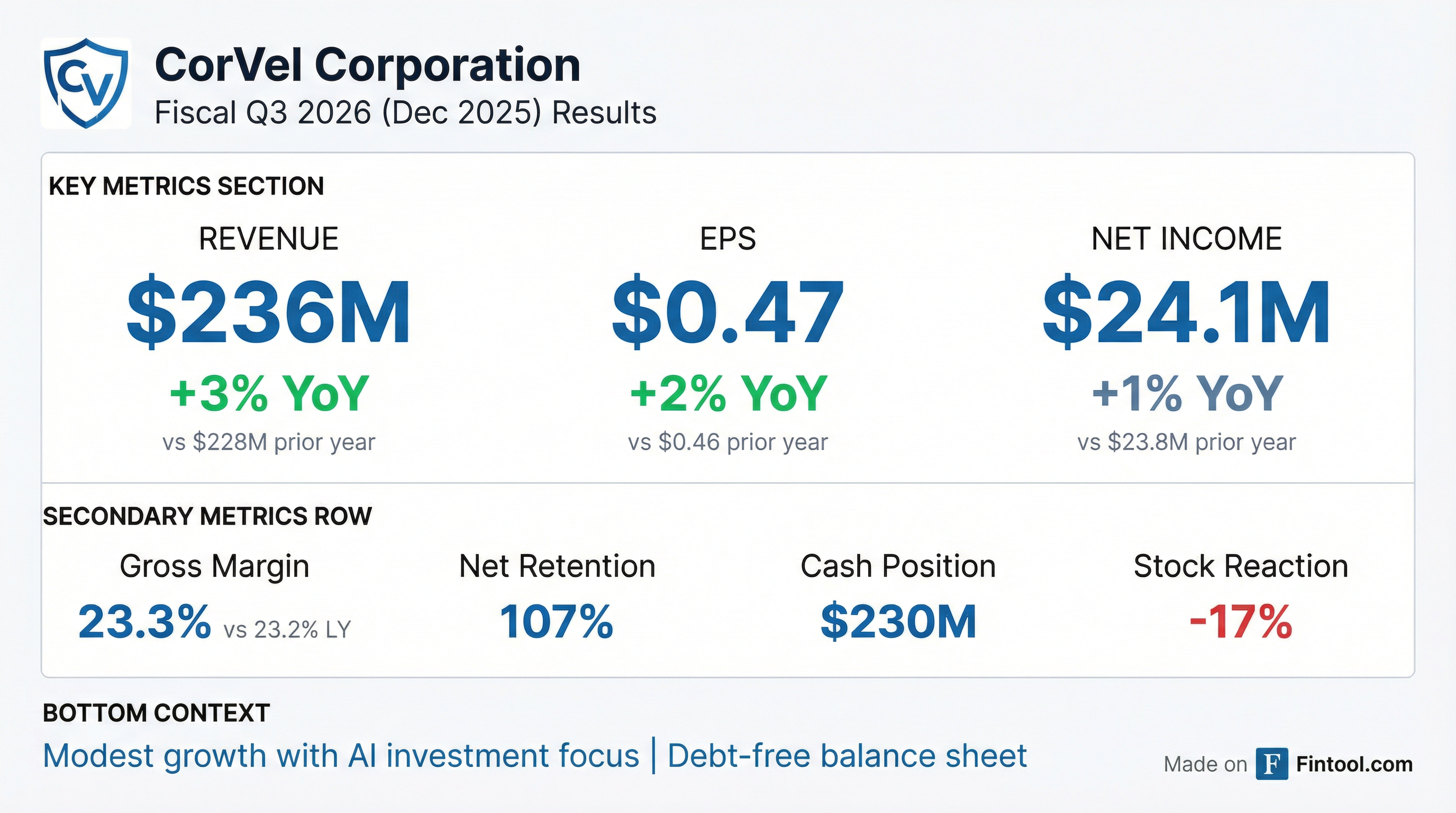
CorVel Corporation (CRVL) reported Q3 FY2026 results that showed continued growth but at a decelerating pace that spooked investors. Revenue rose 3% year-over-year to $236 million, while diluted EPS increased 2% to $0.47 . The stock plunged 17% to $57.85 on the news, hitting a 52-week low as investors reacted to what management characterized as "modest relative to expectations" results .
The workers' compensation and healthcare payment integrity company pointed to tax rate normalization as a key headwind, noting that an increase in the effective tax rate "tempered earnings results" despite operational improvements . CEO Michael Combs emphasized that the quarter reflected "short-term operational factors rather than a change in fundamentals" .
Did CorVel Beat Earnings?
CorVel delivered positive year-over-year growth but decelerated meaningfully from year-to-date trends:
Year-to-date metrics tell a stronger story, with revenue up 7% to $710M and EPS up 16% to $1.53 compared to the same nine-month period last year . The deceleration in Q3 from this pace appears to have disappointed investors.
 Ask Fintool AI Agent
How Did the Stock React?
CorVel shares plunged 17% on February 3, 2026, falling from $69.75 to a low of $57.56—a 52-week low. The selloff erased approximately $500 million in market capitalization, bringing CRVL's market cap to roughly $2.95 billion.
The stock is now trading 55% below its 52-week high of $128.61, reflecting a broader derating as growth has slowed and investors question the sustainability of the premium valuation.
What Changed From Last Quarter?
Revenue Deceleration: Q3's 3% YoY growth represents a notable slowdown from Q2 FY2026's 7% growth and the 7% YTD pace. This is the slowest quarterly revenue growth rate in recent history.
Tax Rate Normalization: Management explicitly called out that the effective tax rate increased after "an extended period of lower than average levels," which compressed EPS growth despite operational improvements .
Sequential Revenue Decline: Revenue of $236M was actually down from $240M in Q2 FY2026—the first sequential decline in an extended period. While CFO Brian Nichols noted this isn't unprecedented in the company's history, it clearly unsettled investors .
Increased CapEx: Year-to-date capital expenditures reached $36M versus $24-27M in the prior year period, reflecting "increased spending on proprietary software development and software licenses" .
What Did Management Say About AI?
AI was a central theme in management's prepared remarks, with CEO Combs outlining multiple deployment areas:
Claims Management: AI is being used to provide "rapid understanding of claim nuances and clear prioritization of those tasks requiring immediate attention" when adjusters take on new portfolios of ~125 active cases .
Commercial Health: Technology is helping prioritize which claims to process based on savings potential, as "each claim we select incurs a cost to process regardless of its ultimate savings" .
Case Management: AI is "automating documentation, data synthesis, and routine workflows" to allow clinicians to manage higher caseloads while focusing on complex interventions .
Software Development: Combs highlighted that "Agentic AI is transforming the software development process from ideation to deployment, enabling us to accomplish more, more quickly" with a "very compelling software development roadmap for 2026" .
"As lower-value activities are increasingly automated, we expect meaningful reductions in service delivery costs while simultaneously improving client outcomes. Although pricing pressure is likely over time, we expect cost efficiencies to more than offset any associated fee adjustments."
Ask Fintool AI AgentWhat Are the Key 2025 Highlights?
Management provided several operational metrics for the full calendar year 2025:
The company has repurchased 69% of total shares outstanding since inception at an average price of $7.55 per share—a testament to long-term capital allocation discipline .
What About the Workers' Comp Market?
CFO Brian Nichols provided extensive commentary on workers' compensation industry trends:
Declining Injury Volume: The U.S. Department of Labor reported a small decline in work-related injuries from 2023 to 2024, continuing a decade-long trend that was "magnified at the onset of the global pandemic" .
Rising Severity: Per NCCI, average medical and lost time claim severity increased 6% in 2024, marking five consecutive years of increases .
Medical Inflation: The Workers Compensation Research Institute noted medical costs rising 5-12% across multiple states due to higher provider charges and state fee schedule adjustments .
Labor Market Tailwinds: Job openings are expected to grow in physically demanding occupations including transportation, construction, healthcare, and food service—sectors more susceptible to work-related injuries .
"Collectively, the trends I've shared support the argument that the workers' compensation market is a growing industry for organizations equipped to address its challenges."
CERIS Healthcare Payment Integrity Momentum
Management highlighted strong performance in CERIS, CorVel's healthcare payment integrity division:
- False Claims Act recoveries hit record $6.8B in 2025, with $5.7B from healthcare
- CERIS is seeing "heightened interest from large industry players seeking differentiated, data-driven capabilities"
- A strategic acquisition closed in June is "progressing ahead of plan" with faster innovation and enhanced capabilities
The technology acquisition is generating "meaningful increases in efficiency and effectiveness" with realized ROI "consistent with optimistic expectations" .
Capital Allocation and Balance Sheet
CorVel maintains a debt-free balance sheet with $230M in cash, providing "financial agility" that management believes differentiates the company from competitors with "considerable debt obligations" .
The increase in CapEx reflects investment in proprietary software and licenses as the company accelerates its technology roadmap.
Ask Fintool AI AgentForward Catalysts
AI Deployment Scale: Management expects "meaningful reductions in service delivery costs" as AI automation scales across claims and case management .
2026 Software Roadmap: Combs characterized the development pipeline as "very compelling" with Agentic AI enabling faster delivery .
CERIS Market Position: Growing demand from large payers and continued False Claims Act enforcement create tailwinds for payment integrity services .
Acquisition Optionality: The debt-free balance sheet positions CorVel for "continued strategic product expansion, technological advancement, and acquisition opportunities" .
Key Risks and Concerns
Growth Deceleration: The slowdown from 7% YTD growth to 3% in Q3 raises questions about underlying demand trends and whether this reflects temporary factors or a more structural issue.
Valuation Reset: Even after today's 17% decline, CRVL trades at a premium valuation for a low-single-digit grower in a mature industry.
Pricing Pressure: Management explicitly acknowledged that "pricing pressure is likely over time" as AI drives efficiency gains across the industry .
Market Sensitivity: The sharp selloff suggests the stock had been priced for stronger execution, leaving limited room for disappointment.
The Bottom Line
CorVel's Q3 FY2026 results weren't bad in absolute terms—revenue and EPS both grew YoY, margins improved modestly, and free cash flow remained strong. But for a stock that had commanded a premium valuation, the deceleration to 3% growth, sequential revenue decline, and tax rate headwinds combined to trigger a sharp repricing.
Management's AI narrative is compelling, but investors appear to be demanding proof of acceleration before re-rating the stock. With shares now trading near 52-week lows and 55% below the peak, the question is whether this represents a buying opportunity for patient investors or a warning sign of structural growth challenges ahead.
Read the full transcript: CorVel Q3 FY2026 Earnings Call
Company Overview: CorVel Corporation